
Swain County Court Record Requests
Start a docket search with the free North Carolina eCourts Portal. It works statewide and needs no account. It can pull up a case number, party name, docket entry, or hearing date. It is not the official record, though. That file belongs to the Swain Clerk of Superior Court. Self-service terminals in clerk offices give a local fallback. The counter handles file review, copies, and certifications. A quick phone call can confirm the public-access procedure before you drive over.
- Identify the Swain case number, party name, document title, or date of the record sought.
- Use Portal Smart Search to locate available public case information and confirm the local case details.
- Call the Swain Clerk or visit the public terminal and counter for file inspection, copies, or certification.
- State whether an ordinary copy, certificate under seal, or exemplification is needed, then confirm the charge.
- Use the separate NCAOC public-record request route only for Judicial Branch agency records, not a local Swain case file.
Swain has no published email, fax, or mail-in process for court copies. The post-office-box instruction covers eligible traffic payments only. Call the clerk before mailing anything, since a payment address may not accept a copy request.
Swain Court Record Custodian
North Carolina runs a unified clerk system. So the Swain County Clerk of Superior Court holds the local court records for both trial divisions. That covers criminal, civil, infraction, special proceeding, and estate files. It also includes the records behind magistrate matters. Magistrates sit as District Court officers. They keep no separate county docket of their own. The clerk also maintains the dockets, indexes, and files the Administrative Office of the Courts prescribes. Land and vital records sit elsewhere. The Register of Deeds is not the route for a court file.
Swain County Clerk of Superior Court
Swain County Courthouse
101 Mitchell St
Bryson City, NC 28713
Mailing address: PO Box 1397, Bryson City, NC 28713
(828) 488-7400
Monday through Friday, 8:30 a.m. to 5:00 p.m.
The Judicial Branch court-records information spells out how the clerk, terminal, and copy routes work for anyone requesting a local court record.

Follow that guidance and the practical Swain sequence falls into place. Search the Portal, review the file at the clerk's office, then get a locally issued official copy when you need proof.
Kinds of Court Records
What counts as a public Swain court record changes with case type and access rules. The Portal may display a Case Summary, events, hearings, dispositions, and other public details. The clerk-held file can hold the documents behind those entries. Still, a public display never promises full access. Not every exhibit, attachment, or personal data field is open to download or copying.
- Criminal and infraction case summaries, public docket entries, and qualifying filed records.
- Civil case files, orders, judgments, and public case-event history.
- Estate and nonconfidential special-proceeding materials held through the clerk.
- Magistrate-connected small-claims and preliminary matter files routed through the court and clerk system.
- Official copies, certificates under seal, and exemplifications when the document is public and the clerk can provide them.
Swain Portal Downloads and Files
The Portal shows a Case Summary as an informational public record view. Public documents may appear there, but you have to download them one at a time. Access rules or processing can limit what is available. A Portal printout is not a certified court record. Very large files can trigger Error Code 141011, and the Portal FAQ tells users to contact the Clerk of Superior Court when that code appears.
That boundary matters for a Swain County request. If you need a signed order, a certified disposition, or a document whose public display looks incomplete, the clerk handles the copy process for the local court file. Access limits and applicable charges still apply.
The statute behind the clerk's record-keeping role is G.S. 7A-109, which sets out the rule that separates online viewing from the official record the clerk keeps.
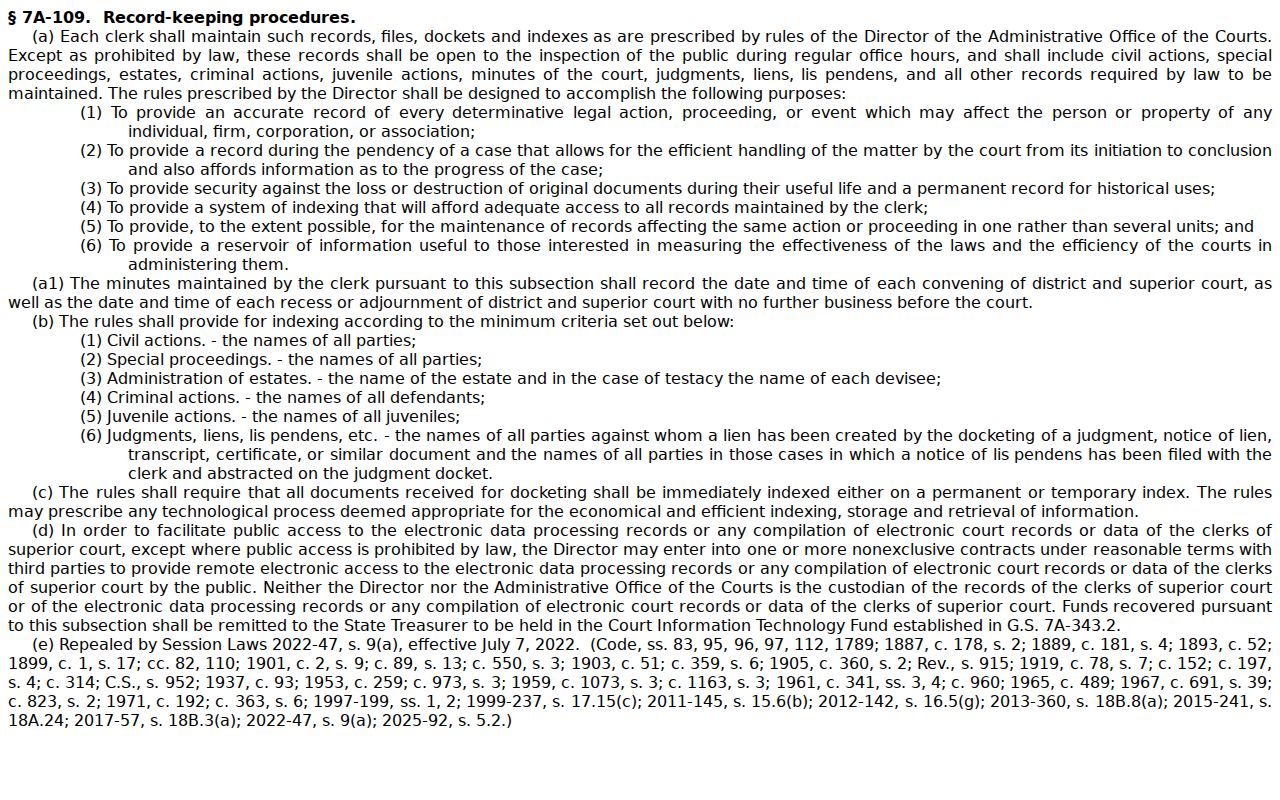
In Swain, that statute's open-record baseline pairs with the clerk's custody of the actual court file. The Portal stays a search tool, not an official-copy service.
Court Records: What They Contain
No two Swain matters fill a Case Summary or court file the same way. Portal sections shift with case type and the public-access setting. The field inventory lists what a public searcher may run into, then the local clerk route for the filing, order, certification, or document itself.
| Case number | Enterprise Justice case identifier, such as the format-only 21CR000003-910. |
|---|---|
| Case and assignment information | Public high-level case facts and available court or assignment information. |
| Party information | Public party names and roles, subject to masking and record restrictions. |
| Case Events | Chronological filings, orders, hearings, transfers, and other docketed actions. |
| Hearings, disposition, and finance | Available scheduling, outcome, and financial sections that must be read in context. |
| Documents and exhibits | Only public documents shown or released under the file’s access rules, not an automatic complete download set. |
Swain Audio and Transcript Requests
A clerk copy, hearing audio, and a transcript are three different products. The Judicial Branch keeps the clerk's records separate from transcripts that court reporters prepare. Not every District Court criminal proceeding gets recorded. A transcript carries its own request process and rate. Use form AOC-G-114 for nonconfidential hearing audio when it is available. Form AOC-G-115 governs confidential hearing audio, which is not released automatically. Have the case and hearing details ready before you ask about audio or a related filing. That helps the clerk tell a court record request from one aimed at a different office. It also keeps a Portal entry from being mistaken for a sound recording or certified proof of what happened.
Copy Fees and Certification
The statewide miscellaneous-cost chart sets the published baseline for Swain clerk copy work. Those figures promise nothing about whether a record is public, what a multi-document request totals, or how long the work takes. Confirm the document, the certification form, and the full amount with the clerk before paying. The $25 criminal record search is a listed clerk service, but it does not replace requesting the court file or running a free Portal search.
| Clerk service | 2026 amount | Swain request note |
|---|---|---|
| First page of each document | $2.00 | Preparation of a court-file copy. |
| Each additional page or fraction | $0.25 | Added to the document copy charge. |
| Certificate under seal | $3.00 | Identify the document and certification need. |
| Exemplification of records | $10.00 | A higher authentication distinct from a normal copy. |
| Criminal record search | $25.00 | A separately listed clerk service under the current chart. |
Recheck fees against the current court-cost publication, since the Judicial Branch can revise the chart.
Swain Court File Request Details
A precise request gets faster results. To pull the right Swain file, the clerk needs a few basics: the case number, a party name if you know one, the document or record title, and a date when available. Say what you want done with it. Inspection, an ordinary copy, a certificate under seal, and an exemplification are different services, so name the one you need. Also state the county. Hearings are a separate matter. If your real question is a public hearing date, use Search Hearings or simply ask the clerk for the current setting instead of ordering a full file. The official courthouse page confirms wheelchair access. It makes no promise about a particular terminal count, same-day certification, a public email request line, or a fixed records turnaround. Call first to confirm the current Swain procedure and ask whether a restricted or older record needs a different lawful route.
Access Rules for Court Records
North Carolina promises a public-record baseline. Court files still have firm limits. The clerk keeps Swain court records open during regular office hours unless a law forbids access, and some material stays outside ordinary public inspection: juvenile files, sealed or expunged material, protected information, and certain audio or exhibits. An empty Portal result settles nothing. It does not tell you the status of a restricted file.
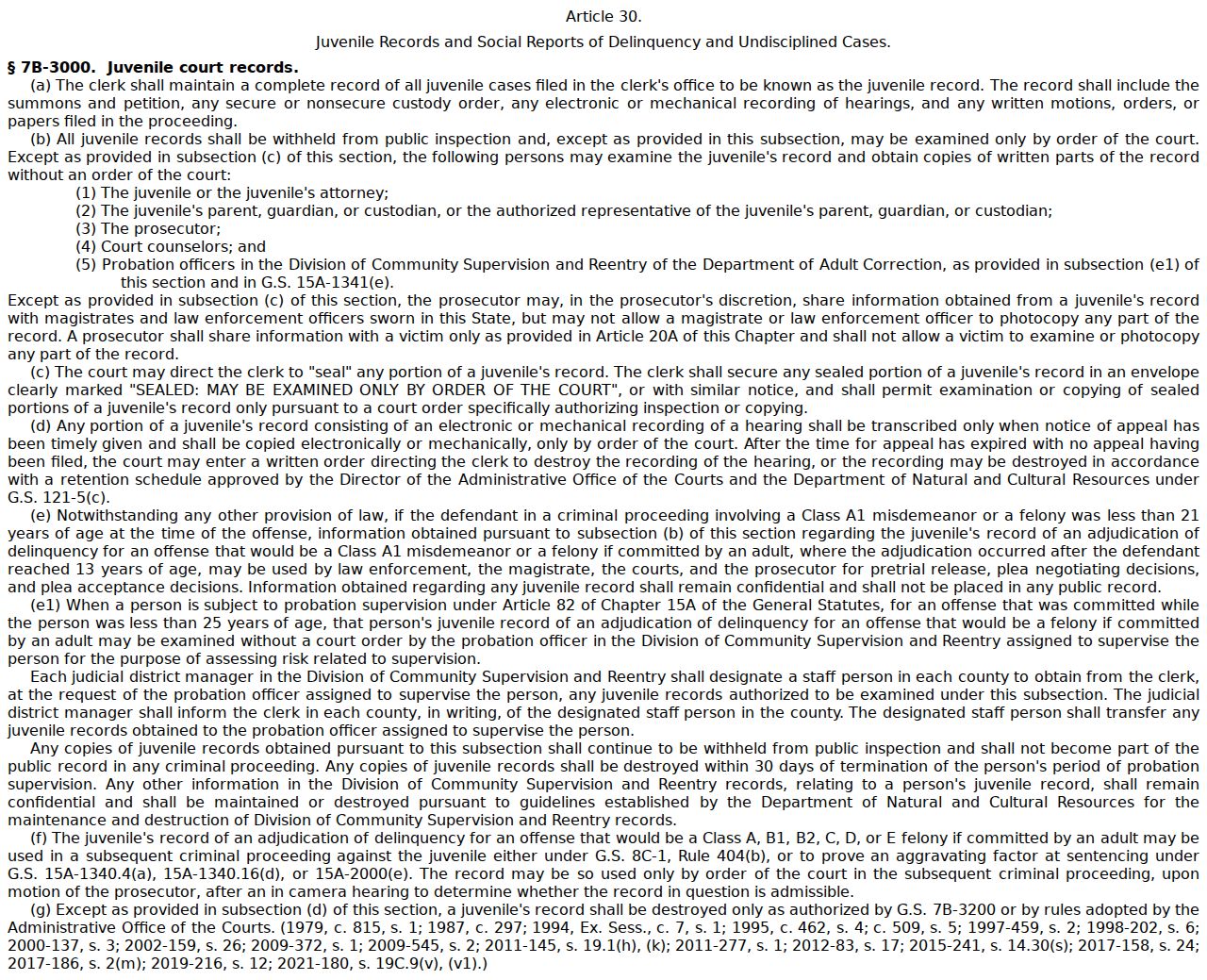
Key access rules: G.S. 7A-109 directs clerks to keep court records, files, dockets, and indexes, with access unless prohibited by law. G.S. 132-1 supplies the public-record definition and cost baseline. G.S. 7B-3000 makes juvenile clerk records confidential. G.S. 15A-145 is one expunction route with eligibility that varies by statute.
The statute on juvenile-record confidentiality closes those files.
For an official answer on a specific Swain court file, ask the Clerk of Superior Court. The clerk can explain the proper local access route without treating restricted material as a public web record.
Swain Court Files and AOC Records
The state form serves a different custodian. The Judicial Branch public-record request form covers existing NCAOC agency records only, and it says so plainly: NCAOC is not the custodian of local court documents or case information. An administrative request can still go through the NCAOC Public Records Request process. A Swain docket, judgment, filed document, or certification is different. Start that with the local clerk. This division spares you a common dead end. State form for agency records. Swain clerk for the case file. One more tip: a document title, a case number, and the requested copy form give the clerk what's needed to identify the correct public record path.