
Swain County Criminal Docket Searches
Start with the free North Carolina eCourts Portal. Its Smart Search tool returns public Case Summary records for the whole state, and Swain County runs on the same Enterprise Justice system, also called Odyssey, that every county adopted in the statewide conversion. There is no separate county docket vendor. If you know the case number, type it in. A party-name search works best in the official last-name, first-name format, and advanced filters can trim a wide result by location, case type, status, or filing-date range.
Treat what you get as a lead, not certified proof. Click the underlined case number to open the Case Summary or Register of Actions, and confirm the case type before reading events, since a person with a similar name may have a different matter in the statewide results. The Portal caps results at 200. A maximum-results notice means you should narrow the search, not conclude you have seen everything the system holds.
- Open the Portal and choose Smart Search for a public criminal or infraction case.
- Enter a case number or a party name in last-name, first-name order.
- Use Advanced Filtering Options after the basic search to select Swain and relevant case details.
- Open the matching case number and read the Case Events, Hearings, Dispositions, and Financial Information sections that appear.
- Use the clerk for a certified disposition, charging paper, full file review, or a question the public display cannot answer.
Swain County Criminal Portal Filters
Smart Search covers the whole state. The location filter is what turns a broad query into a true Swain County docket search. Set it after the basic lookup rather than before. The official training material also lets you search by citation number, record number, attorney details, business name, cross-reference number, or nickname when the case fits those options. Date of birth works as a validation filter. Public displays mask the full date, though, and may show only a birth year. Filters cannot run alone; you need a case number or a name to begin.
Criminal case numbers follow the Enterprise Justice pattern. That pattern is a two-digit year, case-type letters, a six-digit sequence, a hyphen, and a three-digit county identifier. The example 21CR000003-910 shows the shape only. Partial case numbers need at least four characters before an asterisk. A last-name wildcard needs at least three before its asterisk.
Want a published calendar rather than a full case history? The official Swain criminal-calendar interface pairs well with the case search.
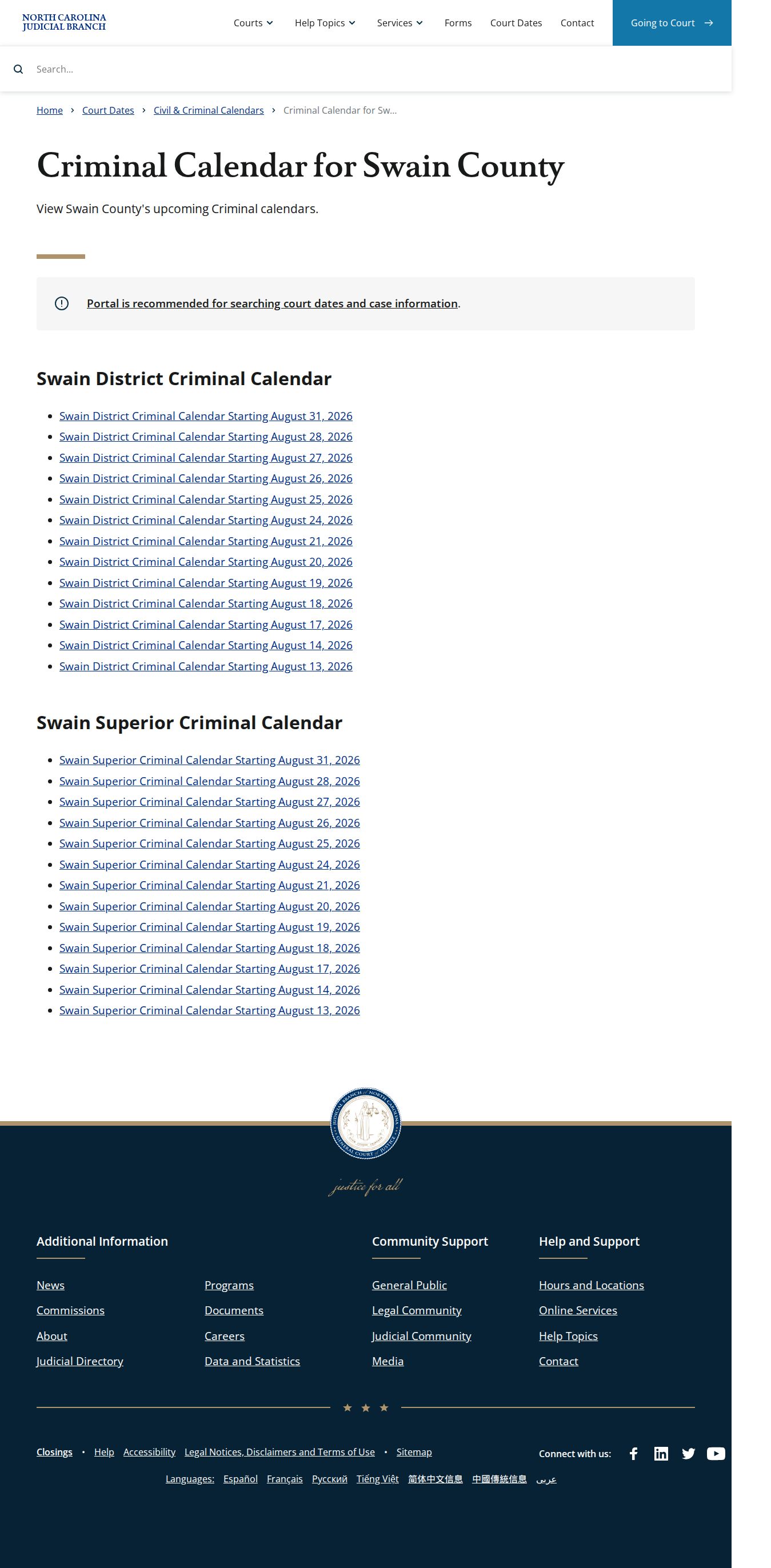
The calendar answers scheduling questions. For the full event history and current case fields, use the Case Summary instead.
Criminal Dockets: What They Show
North Carolina labels the online public docket view a Case Summary or Register of Actions. What it shows depends on the case and the information available in Portal. Expect case and assignment details. You should also find parties and their roles, Case Events, hearings, dispositions, and financial information. Criminal and infraction searches carry their own status and case-type filters. Dates of birth and other protected details appear in public records. That is no license to republish personal information about others.
| Case number | Enterprise Justice identifier, such as the format-only 21CR000003-910, used to open the Case Summary. |
|---|---|
| Case and assignment information | High-level case details and assignment information shown when available. |
| Party information | Public party roles, with privacy limits and masked date-of-birth information. |
| Case events | A chronological timeline of filings, orders, hearings, transfers, and other recorded actions. |
| Hearings and disposition | Current hearing information and recorded resolution fields when those sections apply. |
| Financial information | A separate section when applicable; current official amounts require clerk confirmation. |
Some records include public documents you can download, one file at a time. A Portal document error, including a large-file error, is a reason to call the Clerk of Superior Court. Do not assume the document does not exist.
Swain County Criminal Status Terms
Portal status labels mean something specific, and the events around them matter more. Pending tells you the system has not marked a final disposition. It predicts nothing about the next setting. Disposed means a disposition action occurred. The disposition detail holds the real result. Archived is a system status. It does not prove a file is unavailable or expunged.
- Case Event
- A dated filing, order, hearing, transfer, or other recorded procedural action.
- Disposition
- A recorded resolution or outcome field that should be read before drawing a conclusion from an earlier event.
- Transferred to Superior Court
- A Portal status or event that needs its surrounding entry for context, rather than a fixed meaning assigned from the label alone.
- Pending Expungement
- A listed system status, not proof that an expunction order has been completed.
Swain County publishes no local abbreviation list. Rely on the Portal's spelled-out labels, and ask the clerk about any event text you cannot decode rather than importing shorthand from another county.
Criminal Case Stages on the Docket
A criminal docket records procedural steps as they happen. It does not predict the outcome. The court record opens with a charge or filing. An arraignment may follow, along with pretrial settings, motions, hearings, a plea, or trial activity. Read the Case Events chronology together with the disposition fields. One event line alone may not show whether the case has reached a final result.
Docket flow: Filing → Arraignment → Pretrial → Plea or Trial → Disposition → Sentencing.
A hearing calendar is not the whole case file. It points to a scheduled matter, while the Case Summary carries the broader public chronology. For a current setting, Search Hearings and the Swain criminal calendar beat an older event line.
Swain County Criminal Calendar Checks
Portal Search Hearings covers current calendars only. It finds hearings by case number, party, business, attorney, bar number, judicial officer, or courtroom inside a date range. The statewide Portal training resources draw a clear line between it and Smart Search. One tool helps locate the Case Summary. The other shows current hearing locations and times. For civil and criminal calendar links and broader schedule materials, turn to the published Swain local administrative schedules. Hearings do move. The Portal also says nothing about whether an event is virtual or in person. When a court date is close, call the clerk. The display alone is no guarantee of call order or appearance mode. Keep in mind that a criminal calendar lists scheduled settings, while the Case Summary remains the better public record for a case's event history and disposition details.
Swain County Criminal Docket Courts
Criminal dockets in Swain County move through North Carolina's unified General Court of Justice. Misdemeanors and infractions, including most traffic citations, belong to District Court District 43. Felonies and other serious charges go to Superior Court District 43A. The official District Court overview lays out how that division works. It also notes that magistrates serve as District Court officers who handle qualifying small claims, bonds, preliminary criminal matters, and some minor pleas.
The Swain County Clerk of Superior Court keeps records for both trial divisions. So a docket search here begins with case type and the local court record. There is no separate county criminal-court website to check. Magistrate records tied to Swain County stay inside the court and clerk system when they are public, and the state's District Court page shows how misdemeanors and infractions route through this shared records setup.
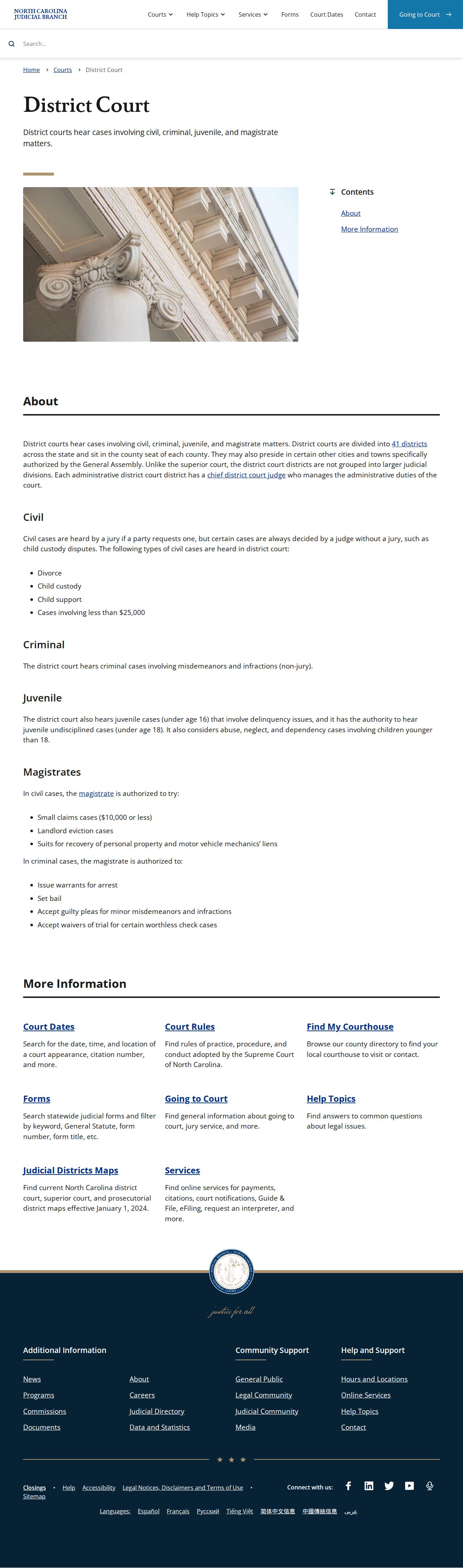
This split matters when reading a public event. It tells you whether an entry reflects District Court activity or a felony matter before Superior Court.
Swain County Criminal Clerk Requests
Need a filed charging paper, certified disposition, complete file review, or court copy? The clerk is the official local source. The Judicial Branch court-records guidance notes that public self-service terminals in clerk offices allow criminal searches by defendant name, case number, or victim or witness name. A terminal is a handy fallback when a public case is hard to locate online or the question concerns a paper-era file. For Swain records, contact the Clerk of Superior Court at 101 Mitchell Street, Bryson City, NC 28713, or by mail at PO Box 1397, Bryson City, NC 28713. The main number is (828) 488-7400. Courthouse hours run Monday through Friday, 8:30 a.m. to 5:00 p.m. State clearly whether you want an ordinary copy, a certified copy, or other official documentation. Portal printouts are not official court records.
Access Rules for Criminal Dockets
North Carolina General Statute 7A-109 directs clerks to keep court records, files, dockets, and indexes. Records stay open unless law prohibits access. That rule does not make every item an anonymous online record. The Portal is informational. Confidential, sealed, and otherwise restricted material stays out of ordinary public view. A no-result search cannot settle a restricted-record question.
Restricted access: G.S. 7B-3000 makes juvenile clerk records confidential except as the statute allows. The Portal FAQ also identifies unreturned warrants and protected material as restricted. G.S. 15A-145 is one expunction route, and eligibility or record availability can vary by law and order.
The official North Carolina expunction information explains why sealed, removed, or expunged material may not be available in an ordinary search. A question about access to a particular Swain case belongs with the clerk or an appropriate legal adviser.
The official North Carolina expunction resource shows why a restricted or absent Portal entry should not be treated as a complete criminal-record answer.

The local lesson is simple. Verify public docket information with the Swain clerk. Do this when an official answer or certified court record is needed. Protected orders and personal data can face extra online limits. Public status and public remote access are separate questions. An official source should confirm the access route for a specific Swain criminal file.
Swain County Criminal Continuance Materials
A criminal calendar entry can change through a continuance. The Swain local rules and forms hub links District Court criminal continuance policy. It also carries other current scheduling materials. A request does not automatically move a hearing. The governing local document and the court's action control whether a new setting is entered. After a reported change, search current hearing information by case number and compare it with the criminal calendar. A historical Case Event may still show the prior setting. For a near-date question, call the clerk. Do not rely on a prior event or an informal recollection of the schedule when the active criminal setting matters.